


Five Spooky Movie Vehicles and the Stories Behind Them
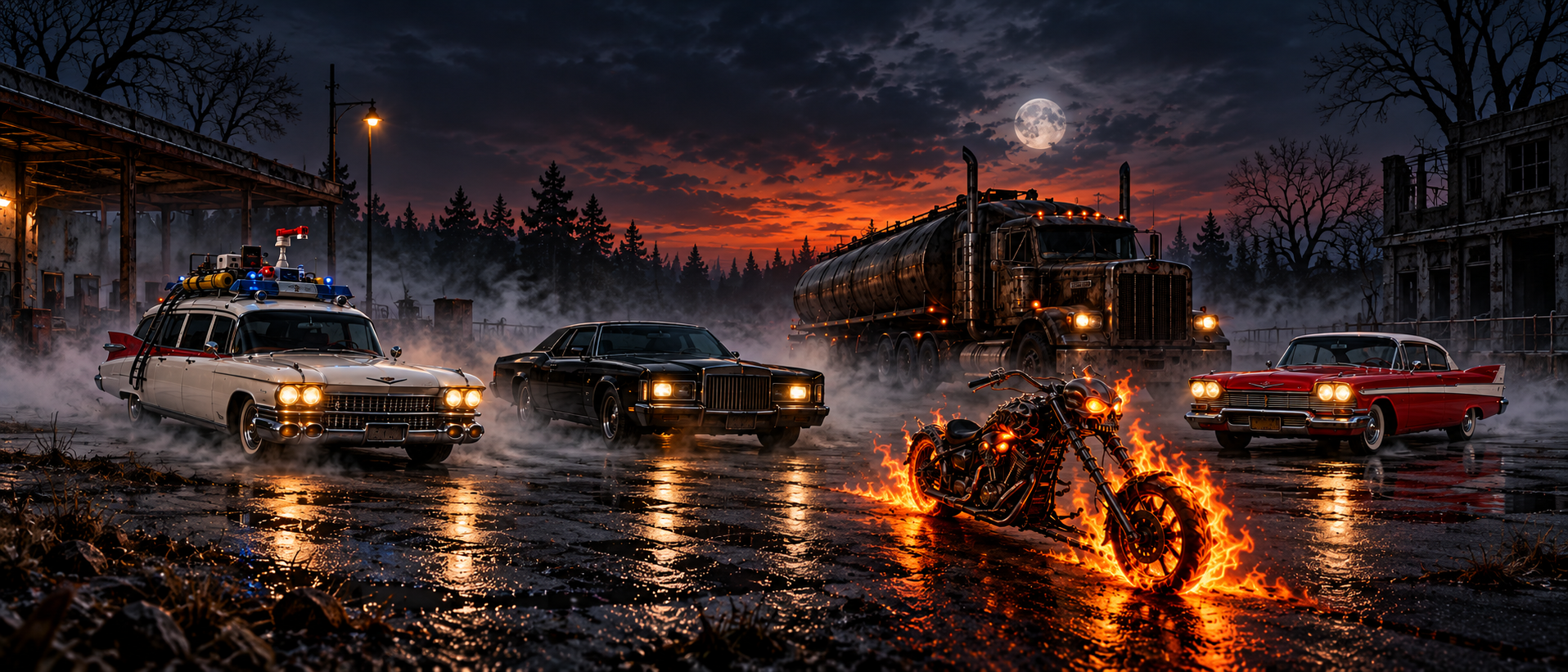
Five spooky vehicles from the movies
Some film vehicles are memorable because they are beautiful. Others become famous because they look fast, unusual or impossibly cool.
And then there are the machines that you really wouldn’t want appearing in your rear-view mirror.
Cinema has produced plenty of unforgettable cars, bikes and trucks, but some have become characters in their own right. Sometimes that came from ingenious customisation, sometimes from clever filmmaking and, in one case, simply choosing a truck with exactly the right face.
For Halloween, we’ve picked five screen vehicles where the machinery behind the movie is nearly as interesting as what happens on screen.
How many would make your own Top 5?
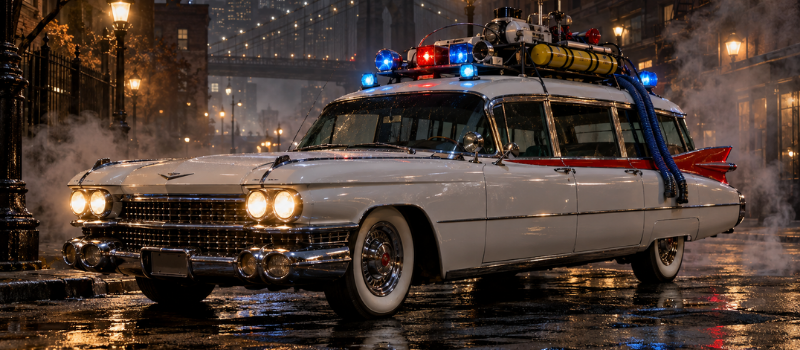
5. Ecto-1: the Cadillac ambulance from Ghostbusters (1984)
Few movie cars can be identified as quickly as Ecto-1.
Underneath all the lights, roof equipment and ghost-hunting hardware is a 1959 Cadillac fitted with a Miller-Meteor ambulance body. Miller-Meteor was a specialist coachbuilder that adapted Cadillacs for professional vehicles such as ambulances and hearses.
That specialist bodywork explains the proportions that make Ecto-1 so distinctive. Its extended roof and enormous rear section offered plenty of room for the Ghostbusters themselves as well as their considerable collection of equipment.
The idea of using an old ambulance came from Ghostbusters co-writer and actor Dan Aykroyd, although his original concept was considerably darker than the car audiences eventually saw. His early vision called for a black vehicle fitted with white and purple flashing lights.
The finished Ectomobile went in a completely different visual direction.
Its lighter bodywork, red fins, roof-mounted technology and instantly recognisable silhouette made it one of cinema's great custom cars. Hardware designer Steven Dane developed and supervised the transformation of the Cadillac into the vehicle seen in the film.
What makes Ecto-1 especially interesting is that the apparently fictional equipment was considered in surprising detail. Years afterwards, when the original car underwent extensive refurbishment, Aykroyd was still able to describe what individual pieces of equipment mounted on its roof were supposedly designed to do.
The restoration team had rather more conventional mechanical concerns.
Brakes, suspension, steering, electrics and the fuel system were among the areas requiring attention.
Apparently even a supernatural emergency vehicle eventually needs some fairly ordinary garage work.
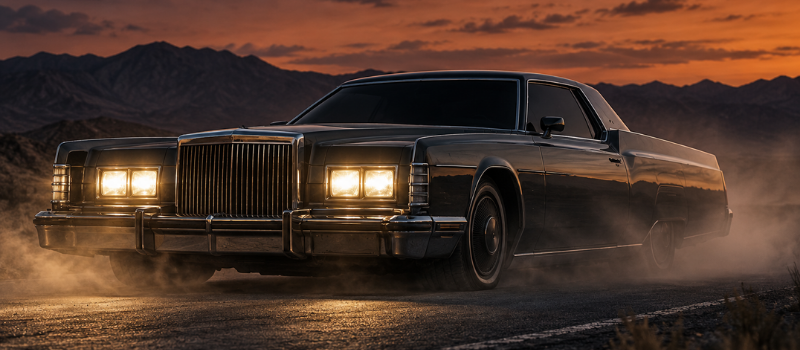
4. The customised Lincoln in The Car (1977)
If Ecto-1 was designed to stand out, the vehicle in 1977 horror film The Car was designed to intimidate.
The sinister black machine wasn’t simply a production Lincoln Continental driven onto a film set. Three customised Lincoln Continental Mark III cars were created for the production.
The design involved legendary Hollywood custom-car builder George Barris, working alongside stunt coordinator Everett Creach. Barris already had considerable experience turning ordinary cars into screen icons, having previously created vehicles including the famous 1960s television Batmobile.
For The Car, however, the objective was less heroic.
The Lincolns needed to appear unusually large, heavy and threatening.
A number of changes helped achieve that effect. The roof was lowered, the sides of the car were raised and the finished vehicles were painted dark charcoal grey. Together, those alterations dramatically changed the proportions of the Continental.
Perhaps the cleverest modification involved the windows.
They were treated so the stunt drivers could still see the road while viewers couldn't see who was behind the wheel.
That was central to the illusion.
Throughout the film, the car behaves as though it has an identity and intention of its own. Removing the visible driver helps the audience stop seeing it as an ordinary vehicle being controlled by somebody else.
And these were substantial machines.
According to the American Film Institute's production history for The Car, each customised vehicle weighed around 5,550lb – approximately 2.5 tonnes.
Not exactly subtle, but subtlety wasn't really the brief.
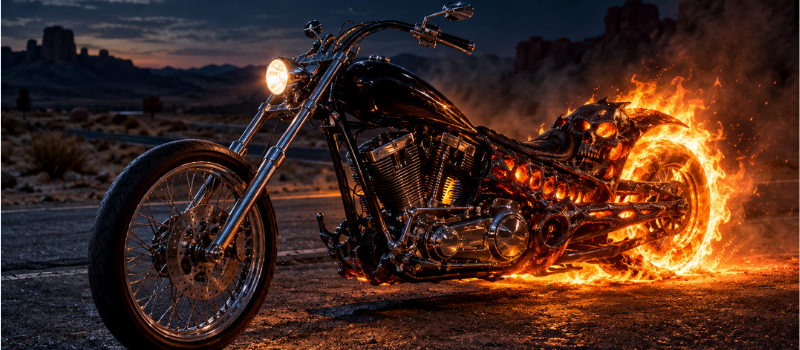
3. Grace and the Hell Cycle in Ghost Rider (2007)
Cars don't have a monopoly on supernatural screen machinery.
In 2007's Ghost Rider, Nicolas Cage plays motorcycle stunt rider Johnny Blaze, whose choice of transport changes rather dramatically when he assumes his supernatural alter ego.
Before the transformation, Blaze rides a custom chopper called Grace.
Once Ghost Rider appears, the motorcycle becomes the much more extreme Hell Cycle – a skeletal, flaming machine that looks considerably less suitable for the average Sunday ride.
There is, however, an important distinction between what Cage actually rode and what audiences see during the supernatural sequences.
Speaking during production, Cage said that he rode Grace, along with a separate Buell stunt motorcycle.
He wasn't claiming to have piloted a motorcycle covered in supernatural flames.
For those sequences, the filmmakers combined a physical interpretation of the demonic machine with visual effects to create the transformation and fiery appearance of the Hell Cycle.
What's particularly interesting is the effort taken to preserve believable motorcycle movement even when virtually everything else happening on screen is impossible.
Director Mark Steven Johnson explained that members of the visual-effects team were themselves motorcycle riders. That practical experience informed details including the way a rider and motorcycle lean through a bend.
It's a small point, but an important one.
When audiences already understand how a real motorcycle moves, getting those fundamentals wrong can make even the most spectacular visual effects look artificial.
Get them right, and it's much easier to accept the sight of a motorcycle travelling down the road while apparently on fire.
2. The tanker in Duel (1971)
Sometimes the most effective movie vehicles aren't heavily modified at all.
They are simply very well cast.
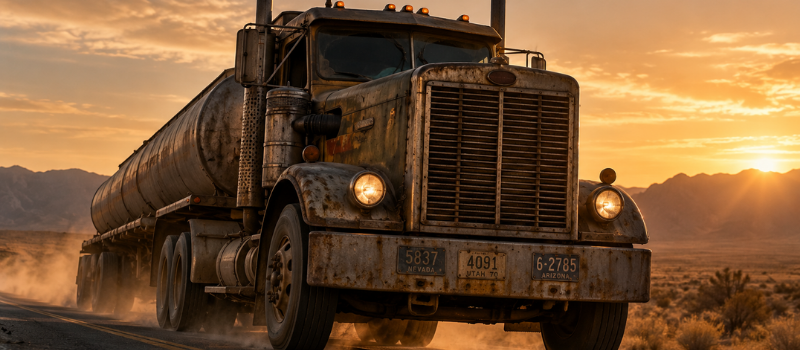
The terrifying tanker that pursues Dennis Weaver's character through Steven Spielberg's Duel is a Peterbilt 281.
Its tall grille, long bonnet, split windscreen and rounded headlights already give it a face-like appearance – which was precisely part of its appeal to Spielberg.
Rather than simply selecting a truck from a list, Spielberg effectively held an audition.
Several different trucks were brought to the studio so he could decide which one had the right appearance for the role. He preferred the Peterbilt's older, long-nosed design to the more modern flat-fronted alternatives.
Once selected, the truck was deliberately made to look as though it had already endured years of hard road use.
It was covered in dirt and grime, reinforcing the sense that this wasn't a well-maintained working vehicle but something that had seemingly been roaming America's roads for a very long time.
There was also a much darker piece of visual storytelling attached to its front.
The production added number plates from several different US states.
Spielberg later explained that these were intended to suggest earlier victims encountered by the truck during its travels.
It's the sort of background detail viewers can easily miss, but once you know it's there it makes the truck considerably more disturbing.
Equally important is the person you don't see.
There are occasional glimpses of the driver – including his hand and boots – but his face is deliberately withheld from the audience.
Spielberg credited that idea to Richard Matheson's screenplay and later summed up the principle neatly:
“The unseen is more frightening than what you throw in the audience’s face.”
The result is that viewers stop thinking about the human being operating the truck.
The Peterbilt itself becomes the antagonist.
Originally produced for American television and broadcast in November 1971, Duel manages to generate extraordinary tension from a very simple ingredients list: two vehicles, an isolated road and one driver who has absolutely no idea why a tanker is trying to kill him.
More than five decades later, it still works.
1. The Plymouth Fury in Christine (1983)
A 1958 Plymouth Fury is already difficult to ignore.
Add a supernatural personality and things become rather more complicated.
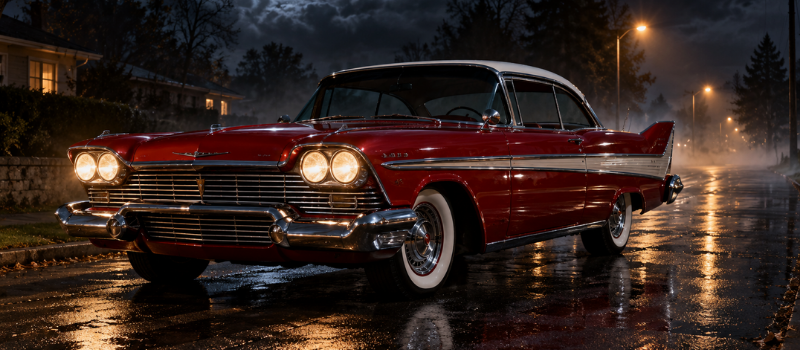
Christine is identified in John Carpenter's 1983 film as a 1958 Plymouth Fury, with the styling you'd expect from an American car of the period: dramatic tailfins, a broad chrome grille and plenty of brightwork.
Then there is the colour.
Christine's red-and-white finish makes sure she stands out whenever she appears, which is rather appropriate for a car that has little interest in remaining in the background.
Based on Stephen King's novel, the film centres on teenager Arnie Cunningham, who discovers the neglected Plymouth and decides to restore it.
As Christine's condition improves, Arnie begins to change too.
What starts as an apparently ordinary classic-car restoration gradually develops into a rather unhealthy relationship between owner and machine.
And Christine is not especially tolerant of anybody who gets between them.
For car enthusiasts, one of the film's most memorable moments comes when the badly damaged Plymouth appears to repair its own bodywork.
This was long before filmmakers could simply hand the problem over to modern digital effects teams.
Instead, the production found a mechanical solution.
A car was hollowed out and fitted internally with hydraulic equipment capable of pulling its body panels inwards. The filmmakers recorded the panels being crushed and then reversed the footage.
Played backwards, the process creates the extraordinary sight of damaged metal moving back into shape.
It's an excellent example of a practical effect whose method is arguably as interesting as the finished sequence.
And that's why Christine takes our number-one spot.
The Lincoln in The Car was extensively modified to look sinister.
Spielberg selected the Peterbilt in Duel because it already looked threatening.
The Hell Cycle was designed to make a custom motorcycle appear supernatural.
Christine is slightly different.
She begins as something many enthusiasts would happily have in their garage: an eye-catching 1950s American classic.
Then the story gradually persuades you that owning her might be one of the worst motoring decisions imaginable.
Although, given the amount of time classic-car enthusiasts can spend talking to their cars, perhaps Arnie wasn't the first owner to become a little too attached.
Classic car ownership can sometimes feel like a relationship of its own. Just hope yours never becomes quite as possessive as Christine...
Happy Halloween.
Sources and further reading
Ecto-1: Ecto-1: Resurrecting the Classic Car, which covers Dan Aykroyd’s roof equipment explanations and the restoration work. slashfilm.com
The Car: American Film Institute production history, including the three customised Lincolns, Barris and Creach, the windows and the 5,550-pound weight of each car.
Ghost Rider: Nicolas Cage’s set interview on Grace, the Buell and the Hell Cycle, plus director Mark Steven Johnson’s interview on the motorcycle-riding visual effects team.
Duel: Spielberg’s filmed interview transcript covers the truck casting call, number plates and unseen driver.
Christine: American Film Institute entry for the film and car, plus John Carpenter’s interview explaining the hydraulics and reversed footage. catalog.afi.com
